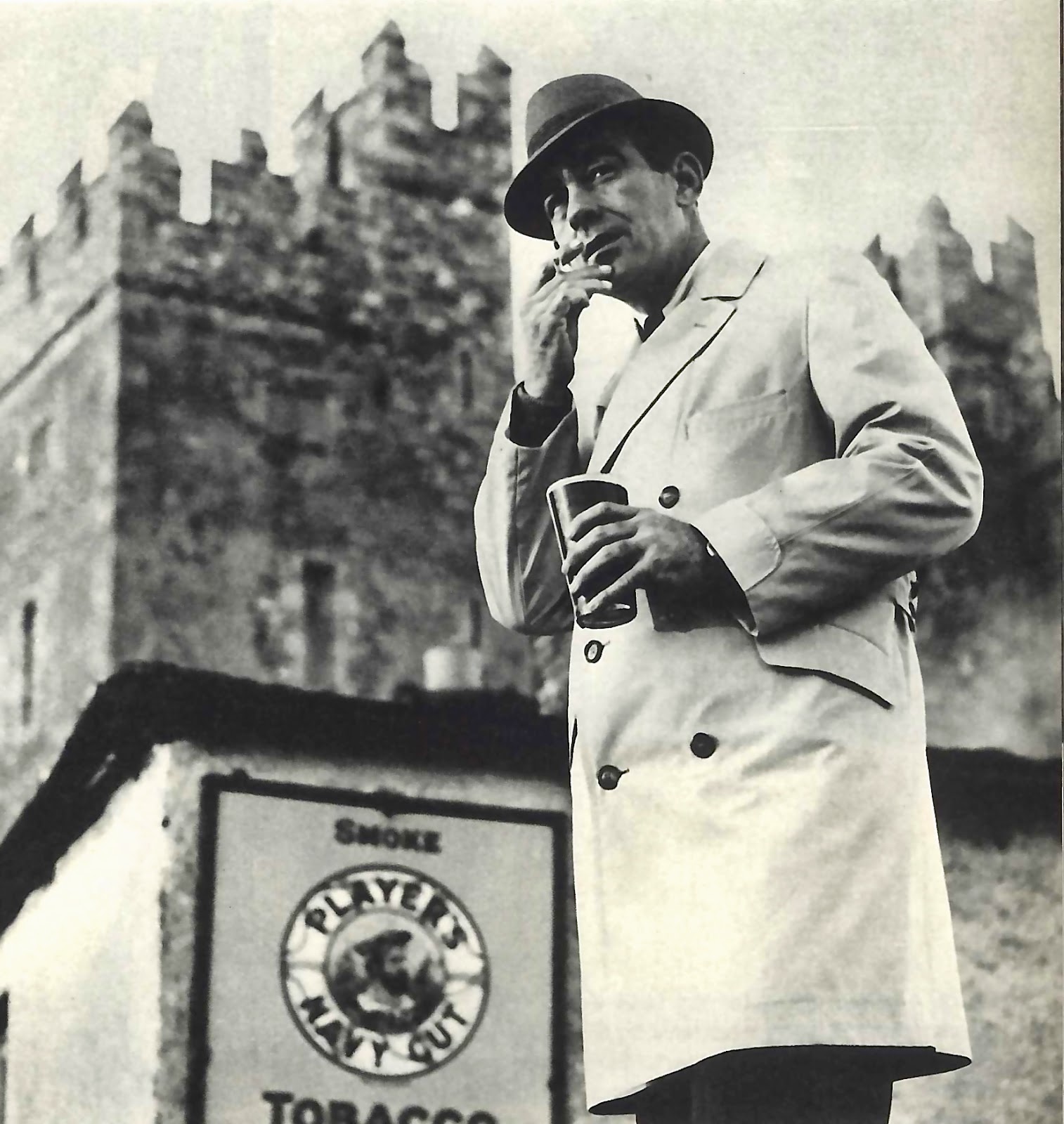
While GQ seemed to be the smaller and more intellectually challenged little brother of Esquire, and I've waded thru years and years of both….GQ, for a time, stood on firm turf in the early to mid '60s... both visually and in the writing. This April issue celebrated Ireland and it has a moody and dark attitude. I love it.
An GQ is not easy to find and this came from a bound volume so scanning was a challenge. However, inspirational ideas, fashion jargon for 'stealing,' are everywhere despite the binding. Not only in unique layout, photography and stories but in the apparel itself. The nubby stripe shirt reminds me of nubby silk Rooster tie stripes -- A mitre madras shirt reminds me of…nothing. It's unlike anything I've ever seen and I'd kill to have one today. A rain coat with hacking pockets and sleeve turn ups? I'd buy that. I'm even saving up for a Jill Gill - - the NYC artist of all those beautiful whiskeys.
I know fashion designers dig thru these old mags but do fashion editors? I'm guessing most do not. And for the very first time, during NY Fashion Week, my hunch was confirmed from widely divergent sources regarding what we'll call, "Fashion editor illiteracy." "He didn't know shawl from peak." "Zip knowledge of apparel history." "I had to explain canvas construction." "All he liked was black." You get the idea.
I sat in front of Nick Sullivan at Esquire and in a couple minutes he showed me a 1950's Mac hanging on the back of his office door and pointed out the construction suggesting it might even be my size. We discussed the military influence of clothing and why stealing unit insignia was not only vulgar but unnecessary. And sure, there was the 24 hour "shoe-cam" which was monitoring what he wore on his feet everyday…but the man was fashion literate. That much you could not argue.
G. Bruce Boyer bemoaned the GQ of today doing a 20 page spread on jeans and t-shirts. It's what they know, Bruce. But I'm guessing there's an archive somewhere in that GQ office and I'd like to suggest it would be a lot more fun to go thru than the PR pitches.
The second you see it - It hits you. I was last here for the Ivy exhibit but the space has grown up. Men and women are in residence having nudged the college kids into storage. The elegance of this space is simple. I run into a young man whom I respect immensely and he tells me he thinks it, 'uncompleted.' I tell him it only gives way, as it should, to the glorious respect of the cloth. Beautifully cut... for men and women both. It is damned near... other worldly and I don't think I'll ever forget it.
The Fashion Institute of Technology is not the kind of place you'd suspect has a museum -- Especially in New York City. It stands at 27th and 7th Avenue looking more like a concrete federal office building than a fashion institute. The museum entrance is on the south side of 27th, usually blocked off, adding to the federal feel of the place. Inside, a flight of stairs down, is an exhibit area darker than the inside of a goat. A quiet calm settled in as the 1930s stood, and sat, in front of me -- Men and women and the clothing they wore and, I like to think, took off each other.
Co-curated by the museum's, Patricia Mears and writer, G. Bruce Boyer, the clothing hails from the 1930s. It was a time of economic and political, 'shit hitting the fan' but as Boyer has often written, it was, despite the uncertainty, the golden decade for apparel. I've always said that today's popularity of menswear has much to do with our own economic hard times. When you're broke and out of a job, there's something to be said for getting dressed up.
Bespoke is everywhere in the exhibit. In that respect, it belongs in a museum's humidity controlled steel locker, wrapped in acid free paper and tucked far from the public's oily fingers. Sorry, I once worked as a museum technician but as clothes mad as I am, I couldn't help but admire how interesting the women's clothing was... it's so alive. Silk clings to a breast and falls off a nipple. Shape forms around a tight waist and bottom while a hip is cocked and a long finger seems to point to my crotch. Wasn't there a very bad '80s movie about a mannequin coming to life?
Menswear saw both the Italian and British represented generously by loans from Rubinacci Napoli London House and Savile Row's Davies and Son. Luca Rubinacci and I stand together admiring a trench coat from his grandfather's company which began in the early '30s. I point to the gorge of the collar and Luca tells me a story about his father's obsession with collecting vintage London House for a family museum.
Handed down over three generations, his father acquires a Rubinacci white tie jacket made in the '30s and most recently owned by a circus clown who patched it with bandana cloth. Luca tells his father to restore it but his father refuses telling his son, "I don't want what it was -- I want what it became." So do I. Elegance in an Age of Crisis: Fashions of the 1930s Fashion Institute of Technology Exhibit runs from 7 February 2014 to 19 April 2014
A number of legendary singers in the 20th Century made their name during the Big Band Jazz Era 1930 – 1950. Bing Crosby, Frank Sinatra, Nat “King” Cole, Billy Eckstine, and Tony Bennett come immediately to mind, as do Ella Fitzgerald, Peggy Lee, Billy Holiday, and Sarah Vaughn. But there were other incomparable vocalists who came along during that period whose names have seemingly vanished like ashes in the wind. No less a musical genius than John Coltrane pronounced the incomparable vocalist Johnny Hartman – not exactly a household name -- the greatest ballad singer ever. And Mr. Five-by-Five, the ebullient Jimmy Rushing, was the most gloriously happy singer next to Louis Armstrong himself.
And then there was Duke Ellington's favorite singer, Al Hibbler. Hibbler is completely impossible to categorize, thank god we have the recordings.
For most people, Hibbler was the most problematic. He was a peerless stylist with an unforgettable burnished baritone voice that could croon and growl in the same line, but he wasn't even an acquired taste. He didn't have great general appeal, and you either got Al Hibbler or you didn't. He's one of those performers you either adore or don’t understand what the fervor is about. But Hibbler sang like first-degree murder, he was intent to do it. He sang his ardent fans out of their seats at Carnegie Hall dozens of times. Ellington loved him.
It was at a record dance as a teenager I first heard Hibbler's sublime rendition of “When the Lights Go Down Low”, and that was it for me. I've been a Hibbler fan ever since. “When the Lights ...” was something of a brief hit at the time, and was quickly followed by another, “Unchained Melody” (originally the musical theme of the film “Unchained”). There were a few other songs that made the charts, but Al's voice – his phrasing, his accent (often oddly sounding like a Cockney), the timbre (given to the occasional growl, bark, and chortle), the strange rough-and-smooth seersucker quality of his deep, bluesy baritone – was just too uniquely mannered for many listeners. His phrasing had an innate sense of drama combined with an incredible vocal power, yet he was never – and I say this as the greatest possible compliment – a pop singer in any sense of that word. You could categorize him as a jazz singer, a blues singer, a saloon singer, or a big band singer, but never as a pop singer.
He was decidedly sophisticated and urbane as a vocalist. He had a wonderful ability to make the most mawkishly sentimental songs seem somehow authentically emotional, so his renditions were completely antithetical to pop music. I’m sure you understand how difficult this is to do, given the nature of so many adolescent lyrics. His recordings of the poem-songs “He”, “Trees”, and “Old Folks” are in fact majestic, as is his affectingly tender version of the sentimental Irish ballad “Danny Boy”.
And Hibbler had a great influence with other performers. The Righteous Brothers did a hugely successful version of “Unchained Melody” (but then so did Elvis, The Supremes, and Joni Mitchell among others), and there have been numerous recordings of “After the Lights ...” (Marvin Gaye, Lou Rawls, and Freda Payne among the best). None comes anywhere near the originals by Hibbler. To my mind, no one could.
Albert Hibbler was born in Tyro, Mississippi in 1915, blind. He first recorded with Territory bandleader Jay McShann, then Ellington (with whose band he sang for eight years), Count Basie, and Johnny Hodges. His versions of “Don't Get Around Much Anymore”, “Solitude”, “I Surrender, Dear”, and “Do Nothing Til You Hear from Me” (which Ellington wrote specifically for him) are definitive classics by anyone's standards. He was part R&B, part swing, part gospel, and all soul. He won both Esquire’s and Down Beat's “Best Band Vocalist” award, even though real success such as enjoyed by some other Black singers eluded him. Not to mention that Rock ‘n Roll had washed over the land and swamped virtually every jazz singer around.
In the '50s and '60s he became a civil rights activist, was arrested and jailed on several protest occasions. The notoriety and the rapid demise of big band music pretty much finished off Al's career completely, and for the remaining thirty years of his life he recorded rarely. But perhaps his single greatest honor was yet to come. In July, 1971 he was asked to sing at Louis Armstrong's funeral. He chose the song, “Nobody Knows the Trouble I've Seen”. Louis would have adored it. A year after that he made his last album, “A Meeting of the Minds” with saxophonist Rahsaaan Kirk. He spent his last two decades in relative obscurity in Chicago, and died in April, 2001. He was a man of consummate style always.
Selected Discography
Al Hibbler: 1946 – 1949 (Classics)
Al Hibbler: 1950 – 1952 (Classics)
After the Lights Go Down Low (Atlantic)
Monday Every Day: Al Hibbler Sings the Blues (Collectables Jazz Classics)
They simply don’t make ‘em like the Reverend any more. Born in South Carolina in 1896, Gary Davis was a self-taught itinerant guitarist-singer and touring Baptist preacher most of his life. It would have been a particularly difficult sojourn since he was born half-blind, and completely so by his mid-twenties.
But a musician preacher may have been what he was meant to be because he could sure play the hell out of his old Gibson guitar. And every ounce of pain and hope was there in his powerful voice. He was perhaps the last in a long line of religious street musicians. There are still plenty of street musicians, but no one told it like the Rev.
He recorded as early as 1935, mostly gospel songs, but blues – the Devil’s music -- as well. The recording history is as sporadic as his life. After the legendary 1933 recordings on the Perfect label, he recorded again in 1954 and 56, and a magnificent session of “holy blues” in 1960. His “Cocaine Blues” became something of an anthem when he was re-discovered by the 1960s generation of folk singers, the most famous version done by Kris Kristofferson.
And like other old blues singers from the 30s and 40s still alive and brought out of obscurity just short of the grave, he was invited to folk and blues festivals and university concerts from the 60s until his death in 1972. To that generation of hippies and flower-power children, some of whom he even deigned to teach a few licks, he was a living legend. He deserved it. So much for the short account. But not even the most extensive biography can hope to give any indication of his searingly powerful voice and intricate playing style. His voice is like a scorching chainsaw that strips flesh from bone, and the guitar fingering deceptively stringent and simple, a two-fingered Carolina Piedmont style in which the instrument seems to speak directly for itself. Davis is said to have told a fan he only used thumb and forefinger to pluck because that’s all he needed. To hear “Great Change Since I Been Born”, or “Death Don’t Have No Mercy” is to understanding something of religion in the raw.
Like his near contemporaries Brownie McGee and Big Bill Broonzy, also street singers and guitarists, Davis deserves to be better known. He was one of the best guitarists ever to play Afro-American music, sacred or profane, and the immediate intensity in his voice reflects the hellfire and brimstone preachers of the day. His “I’ll do My Last Singing” is as movingly poignant a spiritual as you will ever hear.
There isn’t much delicacy about Davis’s playing and singing, but there’s wonderful nuance and unforgettable style. He could play and sing behind the beat or in front of it, run counter-point all over the place with such a seemingly focused abandonment he sounded as though he was making it all up on the spot. When you think about that all-star band of blues musicians, better save a place for the Rev.
"One of these mornings and it won't be long,
You're gonna call me and I'll be gone,
I belong to the band, Hallelujah."
Discography of the Best: Harlem Street Singer (Prestige/ Bluesville) Rev Gary Davis at Home & Church (S. Grossman's Guitar Workshop) Complete Early Recordings (Yazoo) Live at Newport (Vanguard) Pure Religion & Bad Company (Smithsonian Folkways) Demons & Angels (Shanachie)
G. Bruce Boyer
The Trad: How did you hear about Rev Davis?
G. Bruce Boyer: When I was teaching in the 60s there was a big Folk Music Revival. Folk music never interested me (I remember the great jazz drummer Buddy Rich being asked if he was allergic to anything when they checked him in to the hospital for the last time: "Folk music", he said), but I got some of my some of my students interested in the Blues.
One day one of them came to me with an album I'd never seen, by a blues musician I'd never even heard of: the Rev. Gary Davis. I listened to it then and there, and was smitten: here was a guy whose guitar playing was as good as anything I'd ever heard, and he had a voice that would strip the rusted lug nuts off a 1965 Ford truck. I hate to use a feminine image, but I was vanquished. And that student unapologetically got an "A" from me.
TT: Ever see him?
GBB: By the time I got to know of him, he was only playing big Folk festivals (as I remember), all rather far away from me. So I never got to see him in person. One of the tragedies in my life.
TT: What is it about Davis that connects you:
GBB: I think what connects with me about Gary Davis is the same thing that connects with me about the great English writer Samuel Johnson: (1) the ability to overcome incredible hardship and produce beauty, and (2) the exquisite mastery of their craft. But, when it comes down to it, I'd be content to say that his music simply sears my heart. TT: How do you listen to Davis?
GBB: I like to listen to Davis in my car. I'll put on one of his albums, turn up the volume full blast, and drive around aimlessly. I know this is not environmentally correct, but it's the only way I can listen to him at full volume -- which is the way he should be heard -- and not bother anyone.
L to R, Little Junior Parker, Elvis Presley and Bobby Bland
"I think the year was 1963, and my date was a young Broadway actress who became my first wife. I can't remember the name of the club in downtown Brooklyn for the life of me. Seeing Bobby Bland that night helped get me into the relationship, but the marriage didn't go so well and I had to get out of it myself." G. Bruce Boyer
Bobby “Blue” Bland was born Robert Calvin Bland in Rosemark, Tennessee in 1930. The “Blue” didn’t come into his name until his family had moved to Memphis and he started hanging around the blues joints along notorious Beale Street with cats like B. B. (Blues Boy) King and Johnny Ace.
"If Beale Street could talk, if Beale Street could talk, So many married men would take their beds up and walk. Except one or two who never drink booze, And the blind man on the corner singin’ the Beale Street Blues."
By 1950 Bland started singing with – according to music historian Albin J. Zak –a “loose conglomeration of musicians known as The Beale Streeters. Besides Ace on piano, the group included B. B. King on guitar, Earl Forest on drums, Billy Duncan on saxophone”, with Bobby supplying the vocals, as well as working for other blues musicians doing any odd jobs.
For a while he was B. B. King’s driver after the guitar player and singer had several hit records. Bland himself cut his first record in 1952, about the time a young Elvis Presley probably would have first heard and seen him around that part of town.
He quickly became a part of what was in the air, the incendiary blending of gospel-blues-R&B music that was being developed by Sam Cooke, Ray Charles, Jackie Wilson, Chuck Berry, James Brown and other early 50s musicians into whatbecame known as Rock ‘n Roll.
But it wasn’t until four years after he’d first stepped into the recording studio that Bland cut the song that made him: “Farther on Up the Road”. Thereafter he had hit after hit on the R&B charts – in 1961 he was named #1 Artist of the Year by Cashbox -- even though he never managed to cross over to white audiences then or later.
Bland had a unique voice and style, an unforgettable blend of sweetness and hoarseness, alternately smooth and rough like seersucker, that could whisper like velvet one minute and growl like a wounded tiger the next. The songs that he recorded in the late 50s and early 60s – “Farther on Up the Road”, “I Pity the Fool”, “Cry, Cry, Cry”, Turn on Your Love Light”, and “That’s the Way Love Is” remain exemplars of that incomparable style today.
That’s the short early history of Bland. What isn’t usually noted, perhaps not even remembered, is the power and charisma of the man on stage. I only heard him once in a club in Brooklyn,but it was enough to know he had an incredible stage presence. He wasn’t overtly or typically handsome, but he made up for it in pure scintillating style.
His dress was as cool as you could find: slicked back hair which fell to the side in waves, lustrous lasercut mohair suits of pristine Continental styling, blindingly white dress shirts, highly polished black Chelsea boots with Cuban heels, and that gigolo-thin mustache. And his demeanor charged with sensuality as he leaned into the driving melody.
The women in the audience went wild for Bobby Blue Bland, screaming rapturously with every little gesture or cooing sound he made. They would have torn him from the stage and been on him like a dog on a bone. Everything about him shimmered in the limelight.
Sam Cooke was more handsome, Ray Charles a more creative talent, B. B. King and Chuck Berry hadlonger and bigger careers, James Brown more influential, and Little Richard and Fats Domino appealed more to the teenagers.
But as the big band trumpets and saxes blared out their pulsating tempo, the T-Bone Walker-style guitar filling in the staccato blues notes, the drummer punching away, and Bobby repeating “I pity the fool, I pity the fool, I pity the fool” while cradling the mike in a provocative embrace and rhythmically swaying from side to side, he was one of the sexiest performer to ever come out of R&B.And the most undeservedly unknown to the general public.
So you take it where you find it, or leave it like it is. That's the way it's always been. That's the way love is.
Discography
Bobby Blue Bland: The Anthology (Duke Peacock)
Bobby Blue Bland: Greatest Hits, Vol. 1 and 2 (MCA)
Two Steps from the Blues (MCA)
Midnight Run (Malaco)
Together for the First Time: B.B. King & Bobby Blue Bland (MCA)
That Did It (MCA)
Soul Legend (MCA)
Soulful Sound of Bobby Blue Bland (Half Moon U.K.)
Gary Cooper, photographed by Cecil Beaton, Hollywood, 1931
Gary, Malibu, 1937
Rocky Cooper, Los Angeles, 1933
Gary, Los Angeles, 1940
Rocky & Gary, Southampton, NY, 1934
Gary, Van Nuys, 1933
Gary, Santa Barbara, 1937
Rocky, Colorado Springs, 1942
Gary, Colorado Springs, 1942
Rocky & Gary, Van Nuys, 1934
Gary photographed by Robert Capa, Sun Valley, 1942
Robert Capa, Sun Valley 1942
Ingrid Bergman, Gary & Clark Gable, 1940
Gary, on set, year unknown
Gary & Ernest Hemingway, Sun Valley, 1942
Rocky & Gary, Beverly Hills, 1959
David Douglas Duncan photograph of Pablo & Jacqueline Picasso, Gary & Maria Cooper, Cannes, 1956
Gary, Athens, 1956
Rocky & one of many championship Sealyham Terriers bred by the Coopers.
I first saw proofs of 'Enduring Style' last Febuary during a visit to the publisher. The small B&W images didn't look like much -- until you got close. Close enough to see an intimacy family snaps share. Imperfect exposure. Worn edges. Tape residue. The simplicity of a pose for a spouse or a friend. A happy terrier chases a ball with the shadow of Gary Cooper in the corner. If you love to look at pictures...I mean really look at pictures -- for the stories in the details --you will love looking at this book.
Enduring Style is a return of G. Bruce Boyer during a time when 20 somethings are hoisted sockless up fashion media's flagpole. Finally... there's something to salute. The book is slip cased, monograph-ed and written by three experts. Ralph Lauren contributes the introduction and sums up with a feeling about 'Coop' that proves even Mr Lauren can't always get what he wants.
Maria Cooper Janis, Gary & Rocky's daughter, writes of the charmed, but in no way entitled life of America's premiere movie star who told her, "There ain't never a horse that couldn't be rode, there ain't never a rider that couldn't be throwed." Rather than 'celebrity' and 'star', her description of her father is 'average,' 'good mannered' with 'natural elegance.'
What the photo's leave out, G. Bruce Boyer fills in. The history, the career, the marriage. Like Cooper, Bruce keeps it simple with an eye for detail. Cooper's tailors, shoemakers, colors and jeans. Boyer underlines the contrast between Cooper's celebrity and, 'your average Joe' from Montana.
No doubt Cooper took great care in his appearance and had a passion for the cloth. A vanity that must come with the occupation. But his understanding of what he was doing is breathtaking. Even if he stayed a cowboy extra, his presence in a photograph would tell anyone a hundred years later that this man had something.
The lesson? Style is everywhere, but your inner compass must be followed. Stay true to yourself and with time as your judge, like Gary Cooper, your tie will never be too short, your trouser break never too long and your shoes will never have too many buckles. Simplicity was Cooper's mantra. In the roles he selected and in the way he lived his life. He wasn't a god. He just looked and lived like one.
Enduring Style is available for pre order on Amazonhere. Limited advance copies are also available tonight at a book signing. Join G. Bruce Boyer and Maria Cooper Janis at Leffot, 10 Christopher Street, at 6:30 PM.




 Posts
Posts

